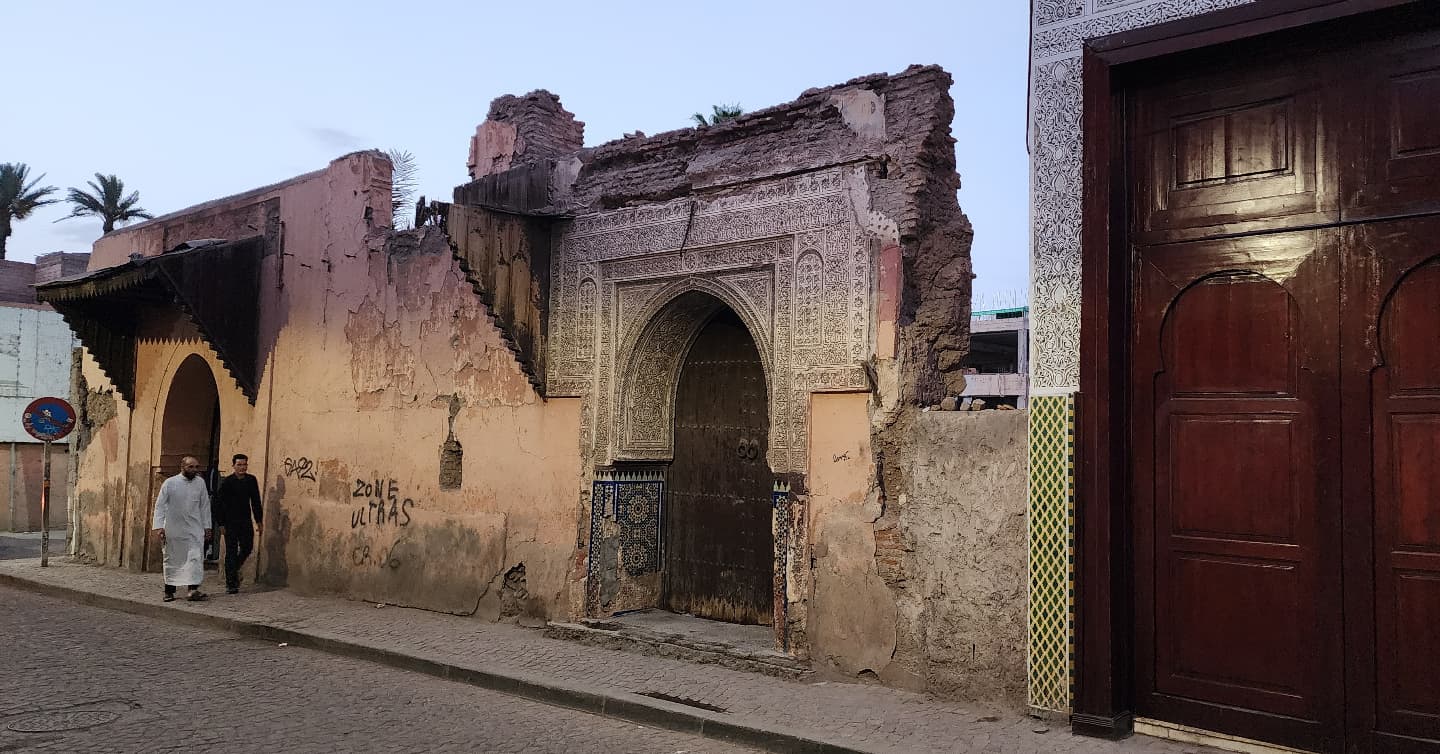
Morocco. The very name conjures vibrant souks, ancient cities, and dramatic landscapes. For two weeks, Todd and I traveled to some of the key cities of this captivating North African nation, exploring history, culture, and food.
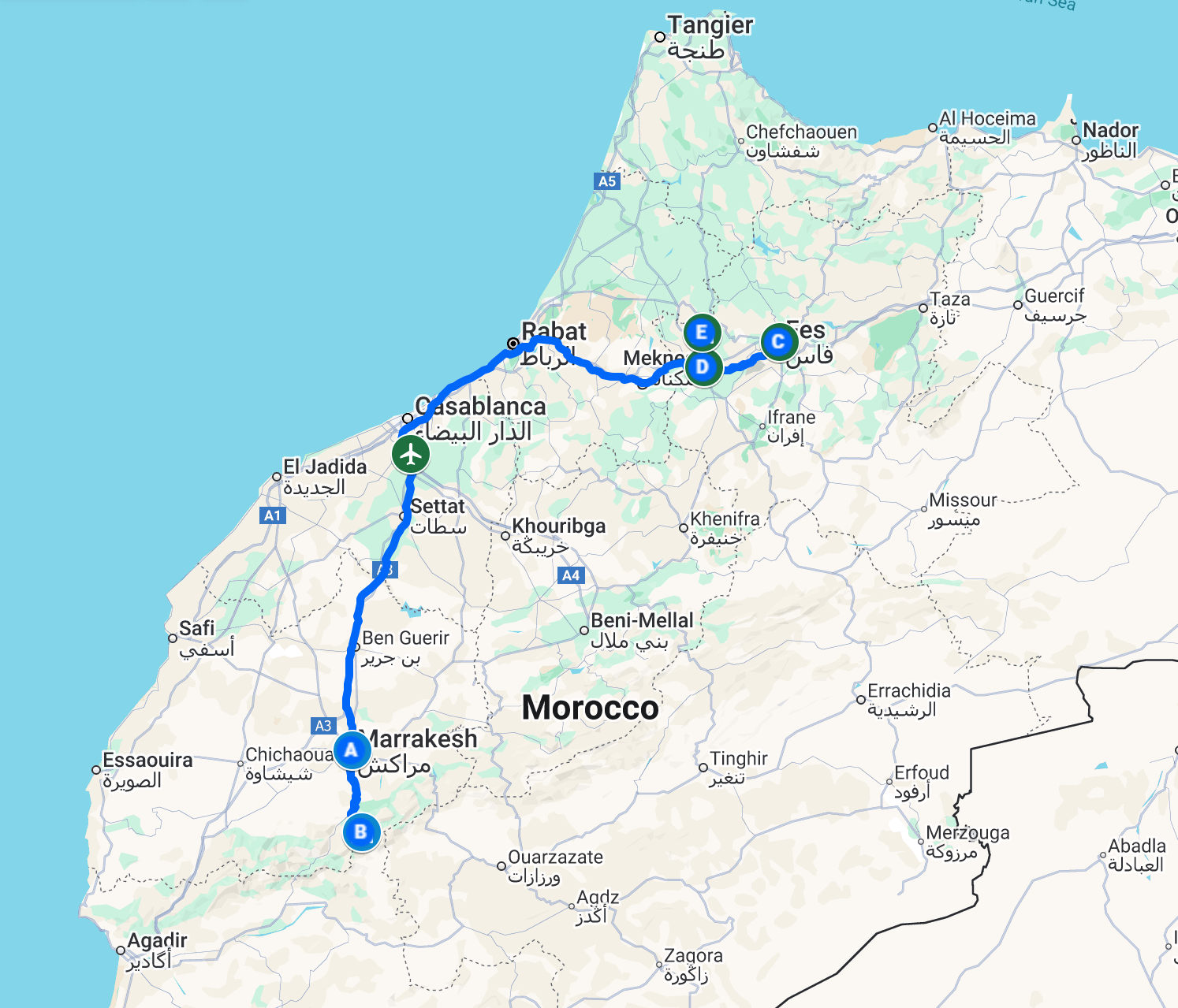
Our trip was an exciting journey that stretched from the bustling heart of the country’s Imperial Cities to the serene tranquility of the High Atlas Mountains, and finally, the echoing silence of Roman ruins.
This was not just about seeing Morocco; it was about unveiling its layers of past, people, and breathtaking beauty, one experience at a time.
The Red City – Marrakech (4-5 Days)
Our Moroccan journey began in the famed Red City, Marrakech. In addition to travel days, we spent about four days in the Red City as we got acquainted with distancing ourselves from home and work. From the moment we stepped into its vibrant embrace, we were swept up in a whirlwind of sights, sounds, and scents. The city’s pulse beats strongest in the sprawling Jemaa el-Fna square. This UNESCO World Heritage site transforms nightly into an enchanting spectacle.

Storytellers captivate crowds, snake charmers entrance onlookers, musicians fill the air with melodies, and countless food stalls offer aromatic delights. It’s an overwhelming, yet exhilarating, sensory feast.
Beyond the square, we plunged into the labyrinthine alleys of the Marrakech Medina. This medieval maze reveals artisan workshops around every turn. We passed mounds of colorful spices, their fragrances mingling in the air. Hidden riads, offering tranquil havens, provided unexpected escapes from the bustle.

We discovered architectural gems like Ben Youssef Madrasa and the opulent Bahia Palace, with its intricate tilework and serene courtyards, showcasing the pinnacle of Moroccan craftsmanship. Their intricate zellij tilework, carved stucco, and cedarwood ceilings are simply breathtaking.


Since I love to cook, it would had been a shame to not spend some time taking a cooking class whilst in the country, so we did just that, learning refined techniques in tagine and other Moroccan cooking. The class began with a market visit to procure fresh ingredients, then we prepared four distinct tagines (chicken, beef, lamb, and vegetable) and two classic appetizers: aubergine salad and Tektouka, all complemented by Moroccan mint tea.
The tranquil Le Jardin Secret, a stark contrast to the lively souks, offered a peaceful oasis of exotic plants. It’s distinguished by two main sections: an Exotic Garden, showcasing a diverse array of flora from around the world, and a more traditional Islamic Garden, designed with profound symbolic and cultural elements.
Marrakech served as our energetic introduction, showcasing Morocco’s modern vibrancy alongside its ancient soul. It set the stage for the depths we were yet to explore.

For more details about our time in Marrakech, you can read my article, Marrakech Travel Guide: Must-See Attractions and Local Flavors.
Atlas Serenity – Imlil (3 Full Days)
Seeking a significant shift in pace, we journeyed south from Marrakech into the majestic High Atlas Mountains. Our destination was the picturesque valley of Imlil.
This marked a complete departure from the city’s hustle, offering crisp mountain air and tranquility. Surrounded by towering peaks, including Toubkal, North Africa’s highest summit, Imlil provided the perfect base for serene walks.

We hiked amidst Berber villages, their mud-brick homes clinging to the hillsides, and walked through terraced fields where local life unfolded at a timeless pace. Our time here was an immersion in local life, experiencing the genuine hospitality of the mountain communities. We savored simple meals and appreciated the quiet beauty of the outdoors.

It was a vital counterpoint to the intensity of Marrakech, allowing us to truly slow down and connect with Morocco’s rugged natural landscapes and its resilient, welcoming people.
For more details about our time in Imlil, you can read my article, From Marrakech’s Bustle to Imlil’s Tranquil Embrace.
Spiritual Heartbeat – Fes (2 Full Days, Not Nearly Enough Time)
From the serene Atlas, a long day of taxi rides and a train journey transported us north to Fes, Morocco’s enduring spiritual and cultural capital.
Stepping into Fes felt like stepping directly into a living museum, a continuous narrative stretching back over a millennium. Unlike the more sprawling, reddish-hued, and tourist-centric Marrakech, Fes immediately struck us as a deeper dive into authentic Moroccan history and intellectual heritage.

Its souks, we found, felt noticeably less pressured than those of Marrakech, allowing for a more relaxed and reflective exploration.
Our explorations focused primarily on Fes el-Bali, the ancient Medina and a UNESCO World Heritage Site. This sprawling, labyrinthine heart is a marvel of urban planning from a bygone era, with its thousands of narrow, winding alleys.


A narrow alleyways in the Medina of Fes.
Here, artisans have practiced their crafts for centuries, their workshops filling the air with the aromas of leather, spices, and mint tea.
We marveled at the intricate zellij tilework and calligraphic details of Al-Attarine Madrasa, a stunning example of Marinid architecture. Its courtyard alone is a masterpiece of geometric patterns.

We glimpsed the grandeur of the ancient Kairaouine Mosque & University, considered the oldest continuously operating university in the world. Even though it was closed for student exams during our visit, its historical weight was palpable from the outside.
A highlight, albeit a pungent one, was braving the Chouara Tannery. From the ground level, we witnessed centuries-old leather-making traditions firsthand – the soaking, the dyeing in vibrant vats of natural colors, and the laborious drying.

The strong, distinct smell was an unforgettable part of the sensory overload. Every turn in Fes el-Bali revealed hidden courtyards, bustling souks, and beautiful public fountains adorned with exquisite tilework.
The sheer sensory overload – the sounds of bargaining, the vibrant colors of textiles, the calls to prayer, and the unique scent of the tanneries – offers an unparalleled journey through time and tradition. It truly invites every visitor to get lost in its enchanting, historical embrace.

For more details about our time in Fes, you can read my article, Discovering Fes: A Deep Dive into Morocco’s Ancient City.
Imperial Grandeur & Hidden Art – Meknes (1 Day)
Our journey continued with a visit to Meknes, the smallest of Morocco’s Imperial Cities. We opted for an overnight stay rather than a day trip, seeking a less touristic experience on our route.
Meknes’s history is dominated by Sultan Moulay Ismail, who reigned from 1672 to 1727. He famously aspired to build a city that rivaled Versailles, transforming Meknes into his capital.

We explored the colossal Bab Mansour al-‘Alj, the grand gateway to his former palace complex. Its intricate design is truly a marvel. We also visited the ornate Mausoleum of Moulay Ismail itself, a site of profound historical and spiritual significance.
The Meknes Medina offered a more relaxed atmosphere than Fes or Marrakech, perfect for simply getting lost and enjoying the quieter pace. It felt more authentically local.

A true highlight was discovering Damasquinerie, the intricate art of metal inlay. This technique, where silver is painstakingly inlaid into iron, is a unique specialty of Meknes.
It’s an endangered craft, and witnessing the work of the few remaining master artisans showcases incredible, centuries-old skill. We found Meknes to be an authentic and understated slice of Moroccan imperial history, full of hidden artistic treasures.


Beyond the history, we learned that Meknes is home to a thriving wine region, one of the few in Morocco producing high-quality wines. While we only enjoyed it at our riad dinner, it’s a unexpected facet of the region. A tour to a winery would had been great, given the time.

For more details about our time in Meknes, you can read my article, Meknes Travel Guide: Discover Morocco’s Underrated Imperial City.
Chapter 5: Echoes of Rome – Volubilis (1 Day)
Just a short distance from Meknes, our final historical deep dive brought us to Volubilis, a UNESCO World Heritage Site. These remarkably well-preserved ancient Roman ruins stand as a testament to Rome’s presence on the very edge of its vast empire.

Walking through the remains of this once-thriving city, we gained insight into the complex relationship between the Roman colonizers and the indigenous Berber people. It was a crucial administrative and agricultural hub, especially for olive oil.
The site is vast, and even with our limited time, we marveled at iconic structures like the Triumphal Arch of Caracalla and the imposing Basilica.

The incredibly well-preserved mosaics in villas, like the House of Orpheus, were a particular highlight, their vibrant colors still astonishing after centuries. It was a fascinating glimpse into a different, equally ancient, layer of Morocco’s rich past.
Our visit also included a brief stop at Moulay Idriss, Morocco’s holy city, nestled in the hills nearby. This town holds the tomb of the founder of the first Moroccan state, Moulay Idriss I. While we could only view the mausoleum from a distance as non-Muslims, its spiritual significance was clear.

For more details about our time in Volubilis, you can read my article, Exploring Volubilis: Discover Morocco’s Roman Ruins.
Our Morocco Unveiled: A Journey of Discovery
Our two weeks in Morocco were a vibrant tapestry woven with ancient history, rich culture, stunning landscapes, and unforgettable encounters. From the electric energy of Marrakech to the peaceful Atlas peaks, the intellectual depth of Fes, the imperial grandeur of Meknes, and the haunting beauty of Volubilis, each destination unveiled a different facet of this extraordinary country.
We traversed a land where traditions are fiercely guarded, hospitality abounds, and every alleyway holds a story. This journey underscored our passion for slow travel – allowing us to immerse ourselves, learn, and connect beyond the surface. Morocco, with its layers of history and sensory delights, truly left an indelible mark. We hope our shared experiences inspire you to unveil its wonders for yourself!
What’s one place in Morocco you dream of visiting?


Leave a Reply