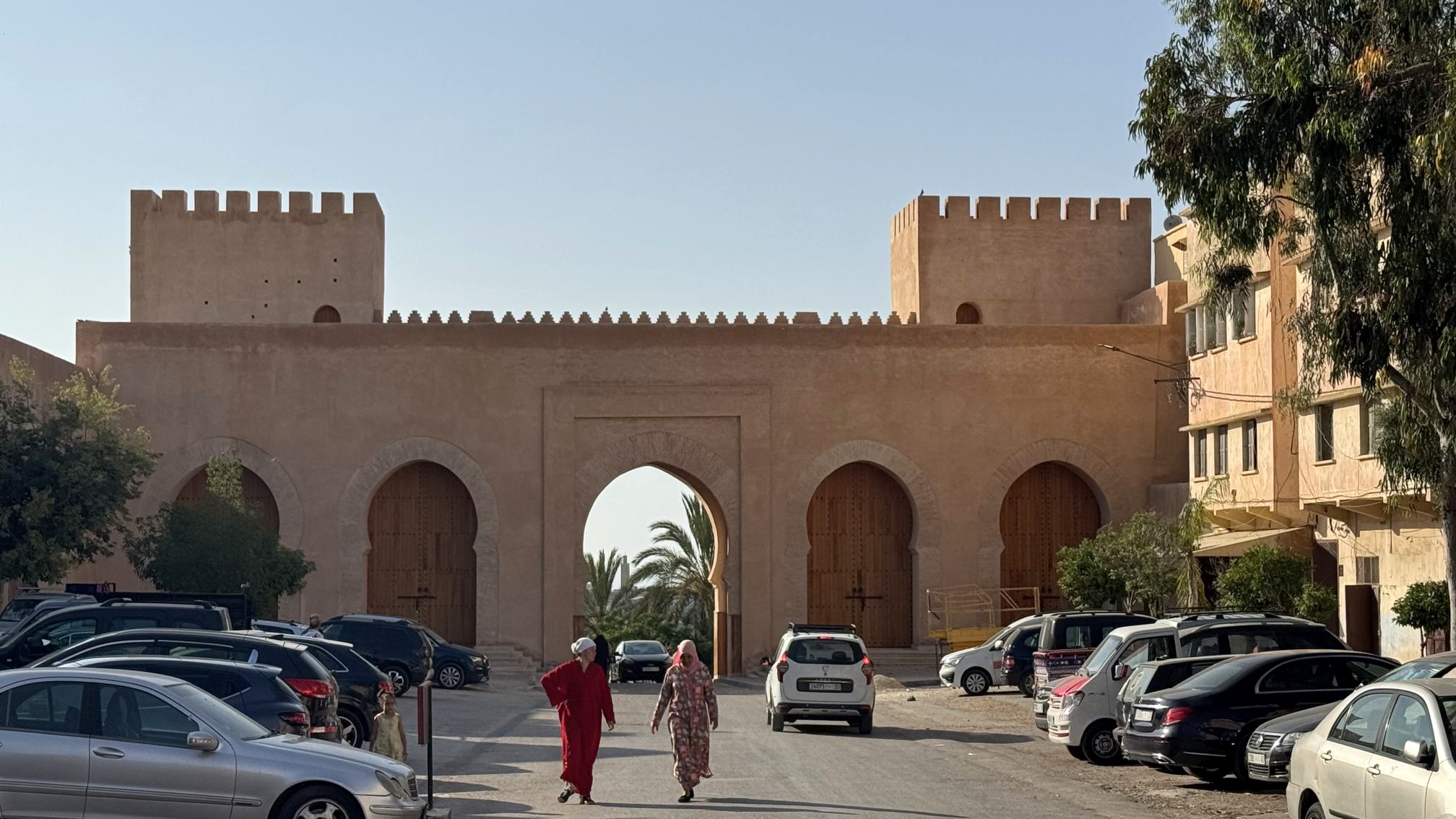
Even though our time in Fes was short, only two full days, I wanted to visit somewhere new on our way home. I had heard of Meknes, knew it was one of Morocco’s Imperial Cities (a fact I’d picked up from the many museums on this trip to Morocco), and understood it was a much lesser-visited location than its more famous counterparts: Marrakech and Fes. Beyond that, my knowledge was limited. Given this curiosity, we decided to break up our journey in the Fes area and stay the night, rather than simply taking one of the many day trips to Meknes that are available direct from Fes. In the end, we had only had the one afternoon to explore, but I was still game. We also planned to see the ancient Roman city of Volubilis, which we’d visit on our last/next day before starting our way home from Morocco.
So, was Meknes worth it? Maybe, maybe not. You decide.

Meknes: A Sultan’s Ambition and an Imperial Legacy
Meknes is the smallest of Morocco’s Imperial Cities, meaning it was one of the capital cities, yet its history goes pretty big. Its imperial destiny was shaped by Sultan Moulay Ismail ibn Sharif, a formidable ruler of the Alawite dynasty who reigned from 1672 to 1727. Moulay Ismail chose Meknes as his capital, aspiring to build a city that rivaled Versailles in splendor.
He embarked on an ambitious construction spree, creating immense palaces, vast granaries, and monumental gates. Indeed, he was the one who famously transported many artifacts and materials from the dismantled El Badi Palace in Marrakech, as I mentioned in a previous post, to adorn his new imperial city. Meknes served as the capital during his 55-year reign, a period of significant military and architectural prowess, leaving an undeniable, if somewhat decayed, legacy on the city’s fabric.

We decided to come to Meknes on our way to Casablanca not only because it is only a short distance, and conveniently on the way, from Fes, but also to experience a less touristic city. We arrived from Fes via train in just around 45 minutes. The Meknes train station is in the newer part of town and just a short taxi to the older portions of the city.
Meknes today is a modern city, but still preserves a smaller, more manageable Medina that dates back to its Imperial days. We checked into our riad, Riad Palais Marouan, which had an absolutely stunning courtyard – a truly impressive welcome! After getting settled in a nice, but relatively basic room, we decided to get out and explore.
Since we came over directly from Fes, we really only had the afternoon and evening to explore, though in June that gave us plenty of daylight.
What to See and Do in Meknes, Morocco? Your Afternoon Itinerary:
Our riad was perfectly situated just on the edge of the Medina, which made it great for a quick start to our exploration of the city. The walk definitely called out that this was a much less visited place than Marrakech or Fes. You can have a lot of fun simply hanging out and getting lost in the small streets of the Medina. I personally enjoyed the lower-key, more authentic crowds – a welcome change from the more intense bustling of the larger Imperial City souks.
I had read mixed reviews, often leaning towards greater negativity, about some of the more famous sites in Meknes. Here’s what we found:
1. Bab Mansour al-‘Alj (Bab Mansour):
This is undoubtedly the city’s most famous gateway, and it is truly beautiful and impressive. This monumental gate overlooks the main square, Place el-Hdim (El Hedime square), and acted as the ceremonial grand entrance to the vast palace complex and royal kasbah (citadel) built by Sultan Moulay Ismail. Though the gate was not finished until 1732, the kasbah of Meknes was first created on this site in 1276 CE; the same year that the citadel of Fes el-Jdid was built in nearby Fes as the new capital of that time. We walked around it for at least half an hour, getting views from near and far, appreciating its intricate designs. There are many other gates in the city, though none are quite as impressive as Bab Mansour.
How to Visit: Easy to access and completely free. It’s a fantastic photo opportunity and the perfect place to start your exploration of the main square.

2. Horse Carriage Rides
We noticed horse carriages throughout the busier parts of the older city, near Place el-Hdim (the main square). Not only were they visible, but quite fragrant as well! We opted not to partake in these, as we generally prefer to explore on foot. For further-out spots, they could be more prudent. I also felt sorry for the horses, often having to just stand and wait in the blistering sun that we experienced (easily in the lower 40’s C, ~100 F in June).
How to Visit: If considering, factor in the heat and ensure the horses appear well-cared for. Agree on a price beforehand.
3. Meknes Medina
The Medina here offered a refreshing change with less pressure compared to the larger Medinas of Fes and Marrakech. It was genuinely enjoyable to simply get lost and wander through the narrow alleyways, seeking out hidden gates, traditional shops, and any other gems that would reveal themselves.
How to Visit: Allow yourself to get lost, but consider using an offline map (like Maps.me or Google Maps) or a local guide if you have limited time or prefer more structure. Embrace the quieter atmosphere.


The Medina of Meknes with many gates and alleyways.
4. Meknes Museum (Dar Jamai Museum)
As we strolled the Medina, we encountered the Meknes Museum (often referred to as Dar Jamai Museum). It cost 10 dirham (~1 Euro) each, so we figured we’d check it out. It was rather small, but I think the greatest disappointment was the fact that there were no explanations for the exhibits. I think we were meant to walk and see some objects, making our own assessment without guidance. I’m sure there was good intent, but I felt as though it were a bit neglected.
How to Visit: Go with adjusted expectations. It’s inexpensive and offers a glimpse into a historic building, but don’t expect a typical museum experience with detailed captions.
5. Mausoleum of Moulay Ismail
This is the elaborate funeral complex for Sultan Moulay Ismail, the very sultan who moved the capital to Meknes. He is buried within his former Kasbah, and the site gets increasingly ornate as you make your way through its various areas. It is an easy site to visit and completely free to enter, which you certainly can’t beat! It is worth knowing some of the history about the sultan beforehand since there is little information provided in and around the complex itself.
How to Visit: Absolutely worth a visit for its architectural beauty and historical significance. Dress respectfully (shoulders and knees covered). Factor in time to appreciate the intricate details.


The room adjacent to Moulay Ismail’s burial place, with intricate details.
6. Place el-Hdim
This is the main square where locals and visitors gather, and where goods are sold. There is also a market just attached. People often say it’s a smaller, less chaotic version of Jemaa el-Fna square in Marrakech, but I think it was a bit quiet on the day when we arrived. Bab Mansour looks over this square, so it is easy to see both together.
How to Visit: Visit in the late afternoon/early evening for more activity. It’s a great spot for people-watching and grabbing a snack from the market.
7. Royal Stables (Heri es-Souani)
These are the ruins of stables that were once home to thousands of Moulay Ismail’s horses. By most accounts, they are considered too expensive for what you get to experience in their current state. We opted out of this one, prioritizing other sites given our limited time.
How to Visit: Research recent reviews to gauge current condition and entrance fees. Consider if historical scale outweighs the current presentation.
8. Souks & Damasquinerie
The souks of the Medina are certainly here, and much like the Medina itself, there is a lot less pressure from vendors than in Fes (which is still my favorite place to shop) and Marrakech. What is truly unique here that the others do not have is damasquinerie. This exquisite art of damascening is the inlaying of different metals into one another—typically, gold or silver into a darkly oxidized steel background—to produce intricate patterns. Here, in Meknes, silver and iron are the key components.
More on Damasquinerie: This technique, highly prized in Morocco, is the specialty of the city of Meknes. It is used to decorate stirrups and sabers, reflecting its historical military and equestrian ties, but also to adorn dishes, vases, and jewelry, making for truly unique souvenirs. This art of inlay is now an endangered skill, and Meknes is one of the last cities in the world where a few rare master craftsmen still practice this painstaking profession. Witnessing this intricate work firsthand is a rare privilege.
How to Visit: Seek out specific artisan workshops in the souks or ask your riad for recommendations to see the process and purchase authentic pieces. When in the shop, make sure that the shopkeep walks your through the process of creating the artwork. It is a very detailed process!
These are not inexpensive pieces, so if you are interested and the shopkeep is giving you too much pressure, move on. There are other people selling who will not hassle you. Also, go a little deeper into the Medina, away from the main square for better deals.


I end up buying a nice damascene vase from this shop. He was a delight without the hassle of some other shops.
9. Meknes Wine Region
What many do not know is that Meknes is also home to a thriving wine region, one of the few areas in the country where high-quality wines are produced. The winemaking tradition in Morocco dates back to the Phoenicians, but it was during the French colonial era that the country began to produce wines on a larger scale. The Meknes region was especially favored by the French settlers because of its Mediterranean climate and fertile soils, ideal for wine production. We did not have the time to partake in wine beyond our dinner table, but I would certainly suggest those with a little more time to get out and explore the local wineries – many offer tours and tastings.
How to Visit: If you’re a wine enthusiast, research local vineyards like Domaine de Sahari or Les Celliers de Meknès beforehand and consider booking a tour. This is best done with a dedicated half or full-day trip outside the city center.
Our Evening & Final Thoughts
After our busy afternoon exploring, it was time for us to settle in for the night. We had a wonderful dinner at our riad. Including us, there were only three groups dining, which wasn’t a lot, but still meant lots of folks asking various questions and ordering meals at various times. It wasn’t long before we noticed that our host was in and out of the kitchen so frequently that we asked if he was the only person back there – being host, waiter, and chef – to which he proudly replied that he was! That was certainly a difficult task and earned our immense respect, especially considering it was a meal of a few courses with several items to choose from. I should also mention that the food was delicious and certainly had more French influence than our previous meals. It was also nice to be staying in a place where wine was available since it had not been for most of our stay in Morocco until that time, except for the bar we went to in Fes.
This was our last real night in Morocco, and we awaited our trip to the nearby ancient Roman city of Volubilis the next day, which would truly cap off our journey before heading home. Meknes might not have the overwhelming grandeur of Fes or the chaotic energy of Marrakech, but it offers an authentic, more relaxed slice of Moroccan imperial history, making it a compelling, if perhaps understated, stop on your Moroccan itinerary.
Helpful Links
- Historic City of Meknes, UNESCO
- Meknes, the Laid-Back City
- Discovering Fes: A Deep Dive into Morocco’s Ancient City
- Exploring Fes Tanneries: A Journey into Moroccan Leather Craftsmanship
- Marrakech Travel Guide: Must-See Attractions and Local Flavors
- Morocco Travel Guide: For my time in Morocco, I have gone with Lonely Planet. This links to the latest version, but don’t be afraid to save a few bucks if there is an older or used version available.


Leave a Reply