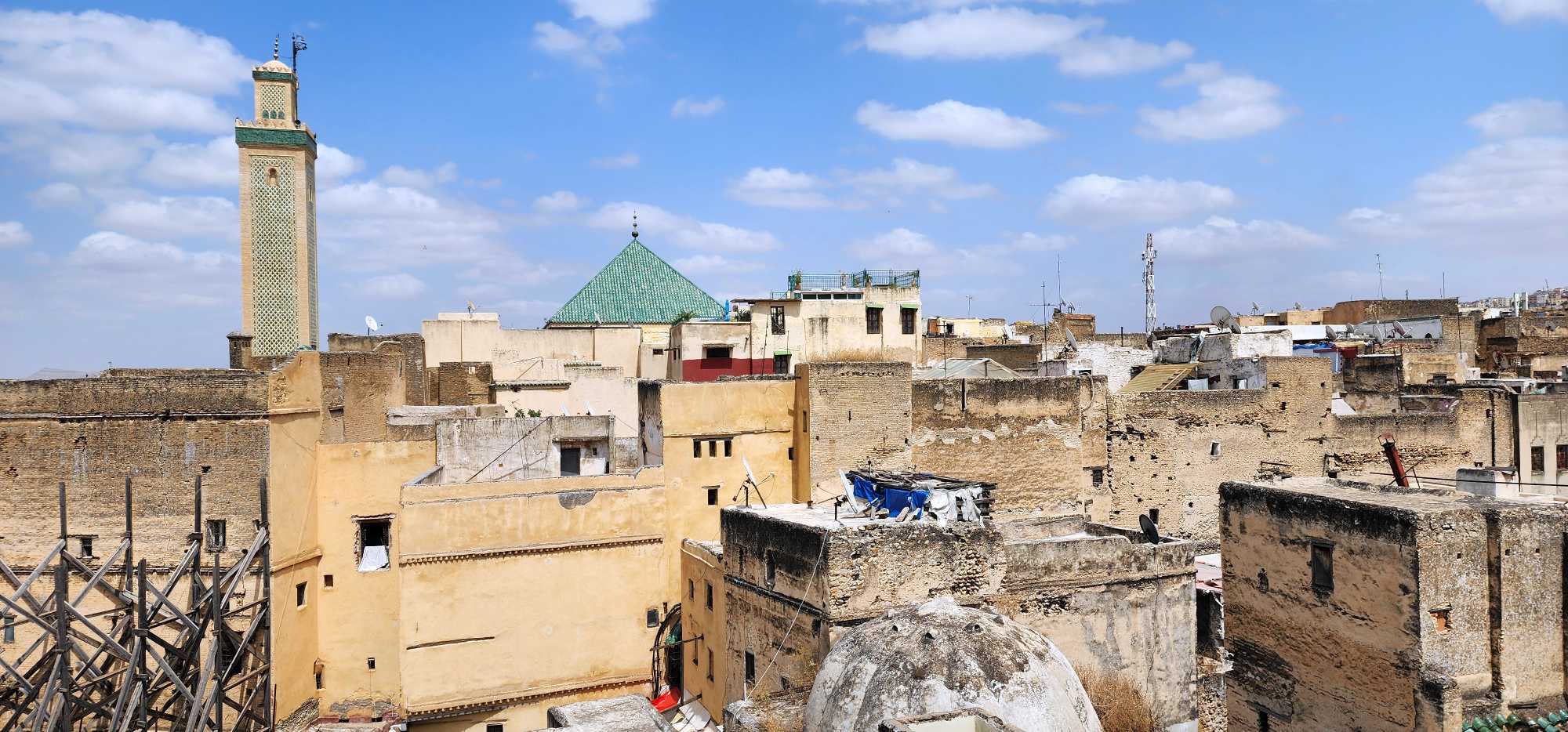
After a very long travel day, starting in Imlil, a picturesque point in the High Atlas outside of Marrakech, it took a couple of taxi rides and a long train ride to finally arrive here in Fes. Though our time here would be limited to just a couple of days, I was incredibly excited to get re-immersed in this ancient city and, of course, buy some of its renowned ceramics.
First thing’s first: from the Fes train station, we made our way directly to our accommodation, Riad Verus, buried just inside the Medina, just around 5-10 minutes drive from the station. We were welcomed with some traditional mint tea and were immediately impressed by the riad’s stunning atmosphere. Here, they offer both private rooms and dorms, and we opted for a comfortable private. While we weren’t the most social during our short stay, the riad also boasts a very nice terrace perfect for socializing and serves a wonderful breakfast. I’d definitely recommend Riad Verus if you’re looking for options in the heart of Fes.


After checking in and getting settled, we were ready to venture out. Stepping into Fes is to step directly into Morocco’s vibrant past. Unlike the more sprawling, reddish-hued, and tourist-centric Marrakech, Fes immediately felt like a deeper dive into authentic Moroccan history and intellectual heritage. Marrakech buzzes with a modern energy alongside its ancient core, but Fes feels almost entirely preserved, a living, breathing testament to enduring cultural depth. I also found Fes’s souks to give off a lot less pressure than those of Marrakech, allowing for a more relaxed exploration. As one of the nation’s largest cities and an Imperial City, Fes is more than just a destination; it’s a living museum, a continuous narrative stretching back over a millennium.

Fes’s story began in the 8th and 9th centuries, originating as two distinct settlements nestled along the Oued Fes (Fez River). These communities eventually merged to form Fes el-Bali, which today is renowned as the Medina of Fes. This sprawling, labyrinthine heart is a marvel of urban planning from a bygone era, with its thousands of narrow, winding alleys and bustling souks where artisans have practiced their crafts for centuries. Historically, Fes has been affectionately dubbed the “Mecca of the West” and the “Athens of Africa,” designations that underscore its profound influence as Morocco’s long-revered spiritual and cultural capital. It’s a place where ancient traditions aren’t just preserved; they are lived, breathed, and woven into the fabric of daily life.


Layers of History: From Golden Ages to Imperial Centers
The city’s significance as a capital ebbed and flowed through the centuries, but it regained formidable prominence between the 13th and 15th centuries. This period marked a true golden age of construction and intellectual flourishing. During this time, numerous madrasas (religious schools) and mosques were constructed or meticulously restored, each showcasing the distinctive hallmarks of Moorish and Moroccan architectural styles. These buildings, with their intricate zellij tilework, carved stucco, and elaborate cedarwood, are works of art that continue to inspire awe today. You’ll also find exquisite public fountains scattered throughout the medina, often adorned with the same intricate tilework, serving as both artistic masterpieces and vital water sources.


A striking example of Fes’s layered history is Fes Jdid (literally ‘New Fez’). This royal administrative district was founded in 1276 by the Marinid sultan Abu Yusuf Yaqub. The establishment of a “new town” in the late 13th century truly underscores the profound antiquity of the city itself – to have a “new” district that is over 700 years old gives a powerful impression of Fes’s deep historical roots and continuous urban development. While this district holds immense historical value, during our short stay, we unfortunately did not get a chance to explore Fes Jdid on this trip, choosing to focus our limited time on the even older Fes el-Bali.
A Living Heritage: Fes Today
Today, Fes gracefully comprises its two ancient medina quarters, Fes el-Bali and Fes Jdid, alongside the much larger and more contemporary urban Ville Nouvelle area, which was founded during the French colonial era. It’s this blend of old and new that makes Fes so captivating.
The Medina of Fes, specifically Fes el-Bali, is not just a historical district; it is celebrated as a UNESCO World Heritage Site and stands as one of the world’s largest and oldest urban pedestrian zones. Stepping into Fes el-Bali is like entering a time capsule, where donkeys and mules are the primary mode of transport through thousands of narrow, bustling alleys, and the air is filled with the aromas of leather, spices, and mint tea. Every turn reveals hidden courtyards, bustling souks, and artisanal workshops. The sheer sensory overload – the sounds of bargaining, the vibrant colors of textiles, the calls to prayer, and the unique scent of the tanneries – offers an unparalleled journey through time and tradition, inviting every visitor to get lost in its enchanting, historical embrace.

Key Places to Experience the Soul of Fes:
Al-Attarine Madrasa: A stunning example of Marinid architecture, this 14th-century religious school is renowned for its intricate craftsmanship, from its zellij mosaics to its carved cedarwood ceiling. The courtyard alone is a masterpiece.

The Kairaouine Mosque & University: One of the largest mosques in Africa and home to the University of al-Qarawiyyin, considered the oldest continuously operating university in the world. While non-Muslims cannot enter the mosque itself, the surrounding area offers glimpses into its grandeur and the bustling intellectual life that has thrived here for centuries. During my time here, this area was closed off for student exams.
Chouara Tannery: A pungent but utterly fascinating experience, the Chouara Tannery is one of the oldest and largest leather tanneries in the world. From the terraces overlooking the pits, you can witness the traditional methods of leather production – soaking, dyeing, and drying – a complex process that has changed little over the centuries.

Bab Bou Jeloud (The Blue Gate): The main, ornate entrance to Fes el-Bali, this masterpiece of Moroccan architecture, adorned with blue and green tiles, is a perfect and iconic starting point for exploring the medina’s winding streets.

Fondouk el-Nejjarine: This beautifully restored 18th-century fondouk (caravanserai or traditional inn for merchants and their goods) now houses a museum dedicated to woodworking, showcasing the artistry and skill of Moroccan craftsmanship. Its central courtyard is a peaceful oasis.
The Jewish Quarter (Mellah): Explore the historic Jewish quarter, notable for its distinct architecture, including houses with open balconies facing inwards. The Ibn Danan Synagogue is a significant site, a testament to Fes’s diverse cultural and religious heritage.
Tombs of the Marinid Sultans: Located outside the medina, these ruins of royal tombs offer not only a glimpse into the Marinid dynasty’s legacy but also panoramic, breathtaking views over the entire Fes el-Bali medina – perfect for photography, especially at sunset.
Ceramic Shopping & Souks: As I mentioned, Fes is world-famous for its intricate ceramics. Explore the workshops outside the medina, where you can see artisans at work, or delve into the souks to find beautiful and unique pieces to take home, from tagines to decorative plates. I ended up buying several serving bowls to complement dishes I’ve collected from other trips.

By exploring these key sites, you’ll gain a deeper appreciation for Fes’s rich history, its vibrant culture, and its enduring spirit. Be prepared to be transported back in time, and embrace the sensory overload that makes this city so unforgettable.
Helpful Links
- Exploring Fes Tanneries: A Journey into Moroccan Leather Craftsmanship
- Riad Verus: A stunning budget riad that we stayed at whilst in Fes.
- Find a Free Walking Tour in Fes Today
- From Marrakech’s Bustle to Imlil’s Tranquil Embrace
- Morocco Travel Guide: For my time in Morocco, I have gone with Lonely Planet. This links to the latest version, but don’t be afraid to save a few bucks if there is an older or used version available.
- UNESCO World Heritage Site: Medina of Fez


Leave a Reply