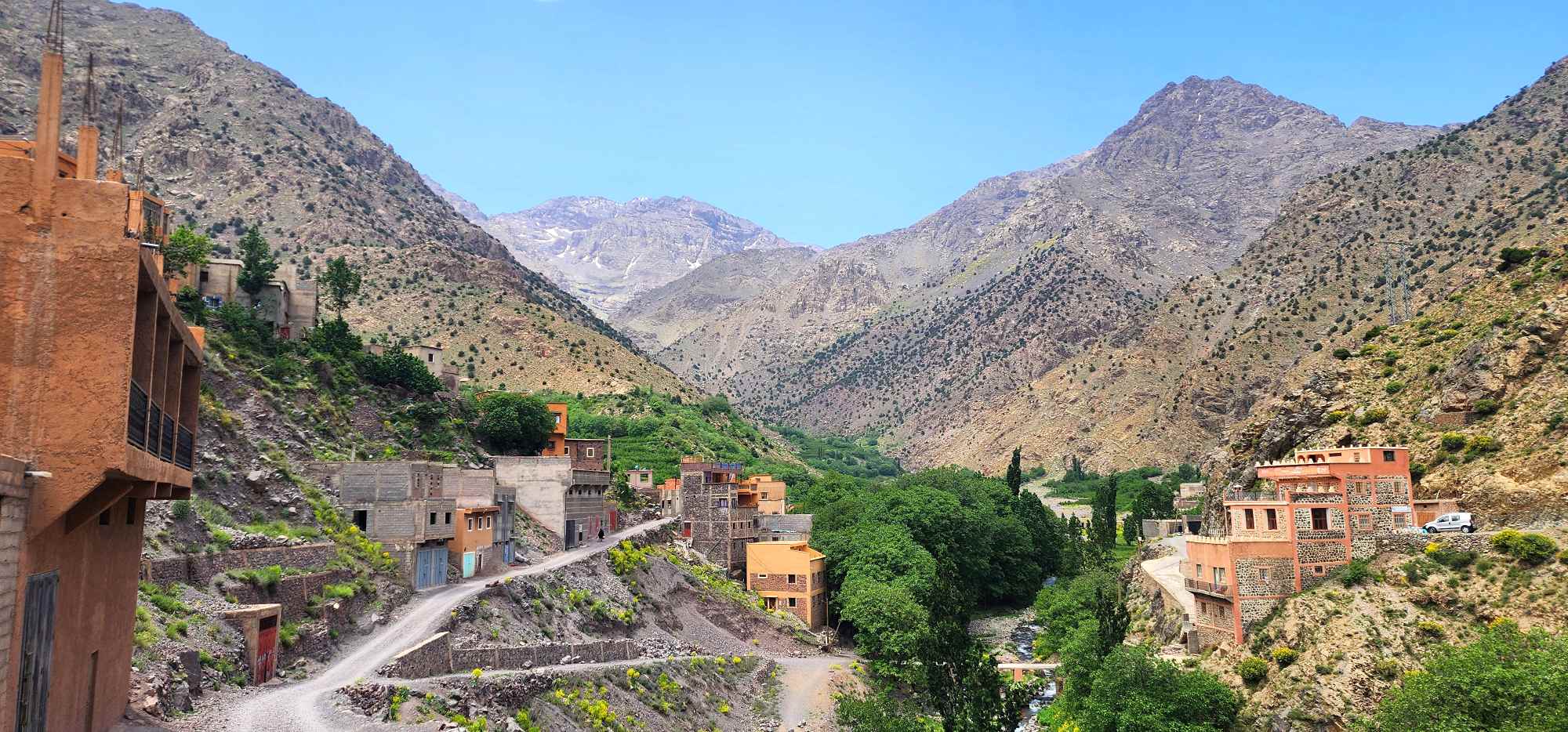
Our Moroccan adventure continued with a significant shift in pace and scenery, trading the vibrant chaos of Marrakech for the serene beauty of the High Atlas Mountains. This wasn’t just a change of location; it was an immersion into a different rhythm of life, one defined by ancient traditions and beautiful landscapes. While the journey from Marrakech to Imlil proved to be a bit of an unexpected mini-adventure in itself, every moment was worth it for the tranquility that awaited.
Having pre-booked our stay at Le Reflet D’Imlil, drawn in by the stunning views on Booking.com, we arrived with high hopes – and I’m thrilled to say, nothing disappointed. Our brief visit was designed for relaxation and deep immersion, a true slow-travel escape.

The journey from Marrakech to Imlil, though slightly more costly than anticipated, was an experience in itself. Our initial attempt to secure shared transport from the King/Grand Taxi station, just outside the Medina, proved fruitless; it was reserved solely for private hires, or so we were told. A brisk walk back to the main square, near our starting point, led us to inquire about shared taxis to Imlil, or at least to Asni as a stepping stone. However, by 11:00, we were told it was too late for shared rides and that we have better chances at 07:00 or 08:00. Faced with no other option, a bit of negotiation, and the driver’s clear upper hand, saw us relinquish to a private fare of 400 MAD (approximately 40 EUR). The upside, however, was an early arrival at our guesthouse in Imlil, a welcome trade-off for the morning’s transport puzzle.
Day 1: Our Introduction to Imlil’s Charms
Le Reflet D’Imlil proved to be a true gem, largely thanks to its wonderful host, Said. After a smooth check-in, Said suggested we explore the local village and then venture up to a local waterfall. The path to the village was a charming footpath winding through the valley’s woods, offering a glimpse into the natural beauty surrounding us. However, these trails are a bit of a labyrinth! We definitely took a few wrong turns, discovering that while all paths eventually lead somewhere, they might not lead to your intended destination, often veering off into farm or a neighboring Berber village. After some backtracking and a few friendly but slightly confusing attempts to ask locals for directions, we finally made it into the main village. There, we savored a delicious lunch of goat tagine (a slow-cooked Moroccan stew), brimming with vegetables – in reality it was more vegetables with a tiny bit of protein.

Following our meal, we set off for the waterfall. While a popular tourist spot, its accessibility and scenic charm make it a worthwhile visit. As we approach, we encountered numerous vendors selling bracelets and other local wares and Todd is lured into web, buying an amber bracelet. At any rate, it gave us something to use when passing other vendors since we could now show it and say that we have already made our purchase. At the lower section of the falls, a small restaurant offers a pleasant spot to enjoy another tagine or a light snack. For a more open and, in my opinion, better view, a slightly higher hike provides a fantastic vantage point of the cascading water.

After our short waterfall hike, we grabbed a light take-away meal and began our journey back to the guesthouse for an early evening. It was during this return walk that those confusing trails I mentioned earlier decided to give us a bit more trouble. Our path led us to a neighboring village, not our own. While only about ten minutes away from where we wanted to be, navigating our way back to our guesthouse required a little more help from the friendly locals. Luckily, we still managed to beat nightfall on our first day of exploring this enchanting area.
Day 2: Delving Deeper into Imlil’s Villages
The next morning, armed with the AllTrails app, we set out to navigate to the nearby village of Aroumd. The Imlil Valley is a fascinating tapestry of smaller, clustered villages, each with its own distinct identity. From a good viewpoint, the minarets of their mosques stand out, marking these individual communities within the broader valley. Aroumd, in particular, holds a special significance as it’s the highest of these villages and serves as the primary starting point for treks to Mount Toubkal.
Understanding Mount Toubkal and the Imlil Valley’s Unique Villages
For those who dream of conquering Morocco’s highest peak, Mount Toubkal stands at a formidable 4,167 meters (13,671 feet). It’s a challenging but rewarding multi-day ascent, typically involving a night or two at a mountain refuge before the final push to the summit. Trekkers are often accompanied by local guides and mules to carry gear, highlighting the strong connection between the local Berber communities and the trekking tourism that sustains many livelihoods here. The climb offers incredible panoramic views of the Atlas range and is a significant achievement for avid hikers.

The villages scattered throughout the Imlil Valley are more than just clusters of homes; they are vibrant hubs of Berber culture and heritage. Life here moves at a slower pace, deeply intertwined with the rhythm of the mountains and traditional agricultural practices. The houses, often built from local stone and mud, blend seamlessly into the rugged landscape. Villagers, predominantly Amazigh (Berber), maintain ancient traditions, from their distinct language and customs to their communal way of life. Agriculture, particularly the cultivation of walnuts, apples, and cherries, forms the backbone of their economy, alongside the growing tourism industry that has brought new opportunities. Exploring these villages on foot offers an authentic glimpse into a way of life that has endured for centuries, sustained by resilience and a deep connection to the land.

Day 3: Sights Over the Imlil Valley – A Gentler Ascent
While many flock to Imlil for the challenging ascent of Mount Toubkal, our holiday in the valley was about embracing a more relaxed pace. It was about soaking in the atmosphere, connecting with the local culture, and enjoying the magnificent views without the rigors of a multi-day expedition. Even our “big hike” was selected for enjoyment rather than extreme exertion. Our host, Said, suggested we hike Talamrout Summit (also known as Tamatert’s Summit), a smaller mountain offering breathtaking views into Imlil and its neighboring valleys.
The hike to Talamrout Summit, while not as demanding as Toubkal, offers a magnificent payoff. The trail winds gently upwards, passing through terraced fields and past small Berber villages, allowing for gradual acclimatization to the mountain air. As you ascend, the expansive panorama unfolds, revealing the intricate patterns of the Imlil Valley below, with its scattered villages and the glistening ribbon of the Assif n’Ouirgane River.
We started from the valley and followed the road up a bit to Tamatert village. From here, you can continue on the winding road, full of switchbacks, or as we did, take some of the charming trail paths. These trails are much more pleasant, providing welcome shade and a more direct route upward. At some point, the road ends, and you become fully immersed in the trail, surrounded by the invigorating scents of wildflowers and juniper. To the east, the towering peaks of the High Atlas provide a dramatic backdrop, their lightly snow-capped summits (end of May) a stark contrast to the verdant valleys. This 5-6 hour hike provides a fantastic opportunity to appreciate the scale and beauty of the Atlas landscape, offering a less strenuous but equally rewarding experience for those seeking awe-inspiring views without the rigors of a multi-day expedition. It’s a perfect illustration of the diverse outdoor experiences available in Imlil, catering to all levels of adventurers.

Day 4: From Berber Villages to Imperial Fes
For our final day in the Imlil Valley, we began our journey towards our next grand Moroccan destination: Fes. Starting out from Imlil’s main taxi station was simple enough. From there, we arrived early, maybe too early, around 08:00. It was closer to 09:00 when we caught our shared ride into Ansi, but unlike our overpriced ride into Imlil, the first portion of this ride was 10 MAD (approximately 1 EUR) each.
This portion of the ride was also a bit comical. We were in the back, stuffed with our bags, in the corner of a van, while some stood around us. It seemed every few minutes of this 25-minute or so ride, some new elderly person got on, creating some very tight fitting version of musical chairs as younger gentlemen struggled to get up from their seats to make room for others. Even the locals were chuckling, with what we assume was the ridiculousness of the situation played on loop for the duration of the journey.
Arriving in to Ansi, we found a few others who were also making their way to Marrakech, and after 25 minutes or so, and another 50 MAD (~5 EUR) each, we were on our way to Marrakech. A short walk to the main square and another 4 MAD (~4 EUR) each got us a bus ticket (Bus L5) to the train station and we were off! It was a long travel day, starting with an early morning shared taxi from Imlil, transferring to a train in Marrakech, and finally arriving in the ancient imperial city of Fes in the evening.

These four days in the Imlil Valley, from the initial, adventurous journey to the tranquil hikes and cultural insights, truly embodied the spirit of slower paced travel. It wasn’t just about ticking off landmarks; it was about immersing ourselves in the rhythms of Berber life, appreciating the raw beauty of the High Atlas, and finding peace in its quiet corners. This journey reminded me that sometimes, the most profound experiences aren’t found in grand monuments, but in the gentle sway of a mountain path and the warmth of local hospitality.
Have you ever experienced the magic of the High Atlas, or found a hidden gem through slow travel? Share your favorite memory or what draws you to this immersive way of exploring in the comments below!
Helpful Links
- Explore Imlil: Gateway to the Atlas Mountains
- Exploring Berber Life in Imlil’s Mountain Trails
- Morocco Travel Guide: For my time in Morocco, I have gone with Lonely Planet. This links to the latest version, but don’t be afraid to save a few bucks if there is an older or used version available.
- Le Reflet D’Imlil: Our Guesthouse in Imlil
- AllTrails: A very valuable app for the phone that shows all of the trails connecting villiages.
- Marrakech Travel Guide: Must-See Attractions and Local Flavors
- Marrakech Bus Lines: L5 is the bus we took from the square to train station.


Leave a Reply