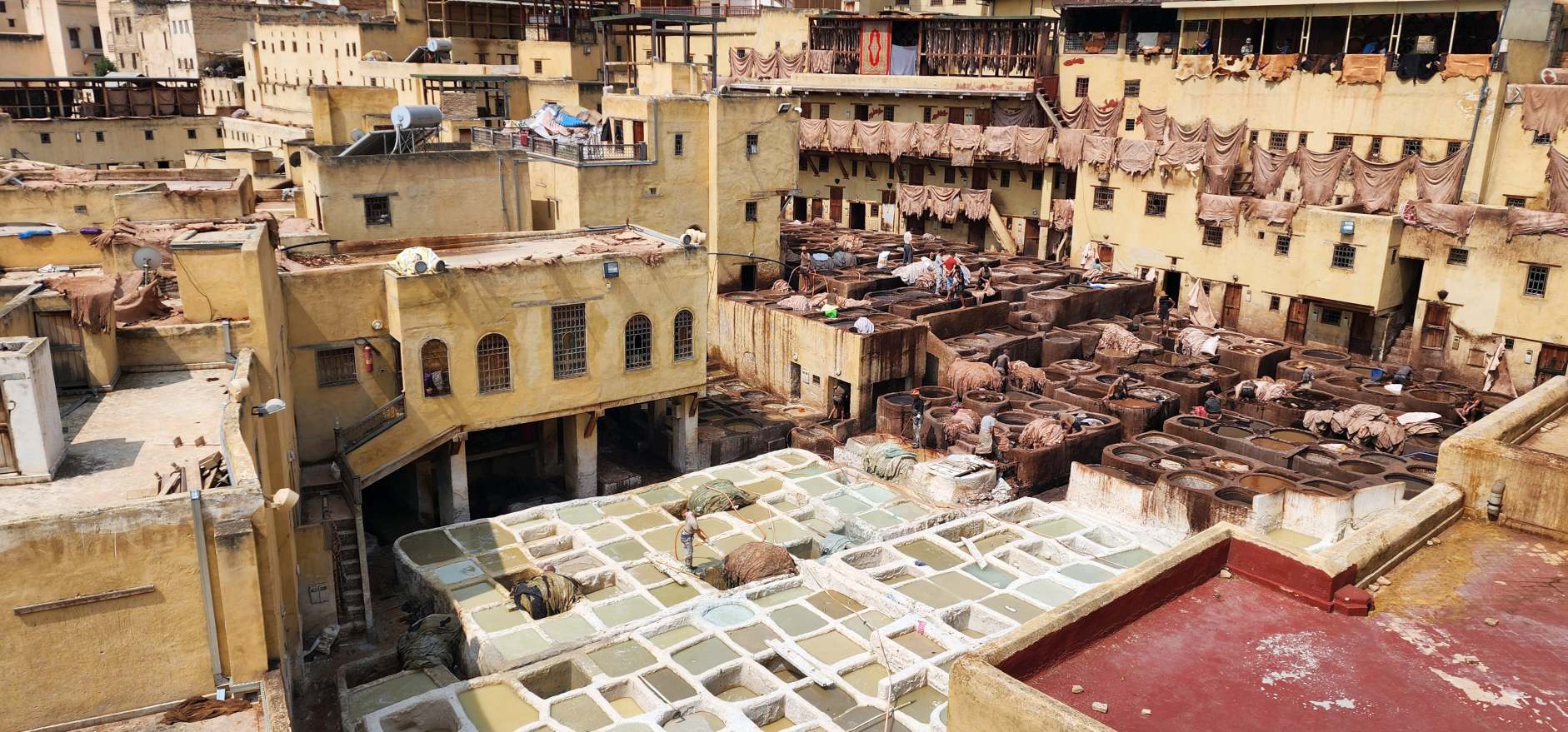
Our time in Fes, the spiritual and cultural heart of Morocco, was shaping up to be an unforgettable journey into the past. After arriving from Imlil and settling into the rhythm of the bustling medina, we knew there was one particular landmark we couldn’t miss – a place where ancient traditions are not just preserved, but vibrantly alive.
Over the last few days, Todd hadn’t been feeling well, so today we wanted to make sure he could get to see one of the most important landmarks in Fes. Since he was feeling a bit better today, we got up and out at a decent hour, and delved deeper into the winding alleyways of the Fes Medina. We were closing in on one particular scene, unique and unforgettable. Eventually, as we neared our destination, the strong, unmistakable scent began to permeate the air, signaling our approach to one of Fes’s most iconic and enduring landmarks: the tanneries.

The Fes tanneries, most notably the famous Chouara Tannery, are more than just a place where leather is made; they are a direct link to a medieval past, a living museum of craftsmanship that has remained virtually unchanged for nearly a thousand years. Here, amidst a breathtaking mosaic of colorful vats, skilled artisans continue to transform raw animal hides into leather using techniques passed down through generations. It’s a visceral experience, a symphony of sights, sounds, and yes, distinct smells, that encapsulates the very soul of Fes’s artisanal heritage.
As we approached the tannery at around 10:30 to 11:00 in the morning, there were all sorts of people inviting us to their shop, all of which have terraces that overlook the large series of vats used in the leather preparation process. This finished leather is destined for the sale racks of the many shops that line the area, or a myriad of worldwide distributors. We chose to keep moving past the initial invitations as we got closer and closer to the actual tannery. Eventually, we found ourselves at two last staircases, both with an eager guide seeking to help us see the tannery. Trusting my gut, I chose the downward stairs over the upward. A man quickly led us down a hallway that opened directly up into the lower level of the tannery; I was very excited to see this sort of view, right from the floor. When I was last here years ago, I saw this leather preparation process from the aforementioned terraces, so a ground-level perspective was a welcome change.

The Centuries-Old Ritual: From Hide to Handcrafted Leather
Stepping onto the ground level of the Chouara Tannery offered a raw, unfiltered perspective on a tradition that predates modern machinery. This isn’t just a process; it’s a centuries-old ritual, a testament to Moroccan ingenuity and the enduring hard work of its artisans. The entire process, from raw hide to finished leather, is a fascinating and labor-intensive journey.

It all begins with raw animal hides – typically from cows, sheep, goats, and camels – sourced from local slaughterhouses. These fresh hides are first plunged into large, deep vats filled with a potent mixture. This initial stage, the “softening” or “de-hairing” process, involves a concoction of quicklime, pigeon excrement (which contains ammonia, acting as a natural softening agent), salt, and water. The hides soak here for several days, breaking down the fibers and preparing them for the next steps. The strong, pungent smell is most pronounced during this stage, a true olfactory immersion into the tannery’s heart.


Once sufficiently softened, the hides are retrieved and then scraped clean by hand. Workers, often bare-chested and knee-deep in the vats, use long, blunt tools to meticulously remove any remaining hair, flesh, and excess fat. This is back-breaking work, demanding immense physical strength and precision, performed under the hot Moroccan sun.
Following the scraping, the hides are moved to another series of vats for the tanning process itself. This is where the iconic colors of the tannery come alive. Natural dyes are used, derived from organic sources such as:
- Poppy flowers for red
- Indigo for blue
- Henna for orange
- Cedarwood for brown
- Mint for green
- Olive oil for yellow
Each hide is immersed in these vibrant, naturally colored solutions, often requiring multiple dips and substantial time to fully absorb the pigments. The natural composition of these dyes not only imbues the leather with rich, lasting colors but also speaks to a deep, traditional knowledge of local flora and sustainable practices.

After the dyeing, the hides are carefully retrieved and laid out on rooftops or surrounding hillsides to dry naturally under the sun. This slow, artisanal drying process further conditions the leather, giving it its distinct texture and durability. Once dry, the leather is then meticulously stretched and polished, sometimes with traditional tools, to achieve the desired suppleness and sheen.
This arduous journey transforms what was once a raw, unyielding hide into the supple, colorful leather that forms the basis of countless Moroccan handicrafts, from intricately embroidered poufs and durable bags to soft wallets and the famous babouches (slippers). Each step is a testament to the skill, patience, and unwavering dedication of the Fes tannery workers, preserving a timeless craft in the heart of the medina.
My Experience and Lasting Impressions
Our guide asked for 100 MAD (Moroccan Dirham) each, and with very little effort, I gave him 140 MAD for the two of us. I am more than sure that price could have been much lower, but being in the midst of the process, along with his insightful explanations, I did not lose any rest over his payment. The raw, intimate view from the ground level was truly invaluable.
After leaving our ground-level guide, he handed us off to a shopkeeper for the more standard view from an upper terrace. From this elevated vantage point, we continued to receive additional explanations of the process and a deeper understanding of the global reputation that Morocco maintains in the creation of quality leather goods. We then had a chance to look over some of the shop’s wares. While I did want a little shoulder bag, the one that I eyed the most seemed to be made of great leather, but one of the zippers felt a bit off. Unfortunately, despite a bit of negotiation, we could not settle on a sale.

From start to finish, we spent just over an hour seeing the tanneries and the goods for sale at the end. While the smells were certainly very vivid – a true olfactory assault initially! – it was an incredibly valued experience to see the hard labor and ancient techniques that are involved in making these traditional leather goods. It was a profound reminder of the history, human effort, and cultural legacy woven into the very fabric of Moroccan craftsmanship. The Chouara Tannery is not just a tourist attraction; it’s a living, breathing testament to Fes’s enduring soul.

Helpful Links
- Discovering Fes: A Deep Dive into Morocco’s Ancient City
- Riad Verus: A stunning budget riad that we stayed at whilst in Fes.
- Morocco Travel Guide: For my time in Morocco, I have gone with Lonely Planet. This links to the latest version, but don’t be afraid to save a few bucks if there is an older or used version available.
- UNESCO World Heritage Site: Medina of Fez


Leave a Reply