Our deep dive into Namibia’s Etosha National Park continued with another unforgettable morning. Leaving our camp at Okaukuejo before dawn, we embarked on a sunrise drive into the central area of the park, eager to see what the new day would reveal. It was this morning that we were thrilled to spot some elusive honey badgers – a truly exciting find for us! However, the undeniable star of the morning was a magnificent family of five lions. We came across them ripping and tearing into their morning breakfast: a powerful oryx. (While we no longer have these photos, the raw, visceral scene is forever imprinted in our minds). We certainly weren’t the first to find these impressive cats, but we secured a prime viewing spot, witnessing the circle of life unfold before us. As we reluctantly departed nearly an hour later, the three other vehicles that had initially shared the sighting had swelled to more than ten, a testament to the allure of a lion kill.

After this spectacular, albeit intense, sight, our compass pointed us towards the far west of the park, to Olifantsrus Camp. The drive itself through this section of Etosha was notably sparse of wildlife, but the destination made up for it. Along the way, we passed several incredibly active waterholes, teeming with a constant stream of thirsty animals, a vital lifeline in the dry landscape. While we continued to spot various grazers, the undisputed theme for the rest of the day was elephants.
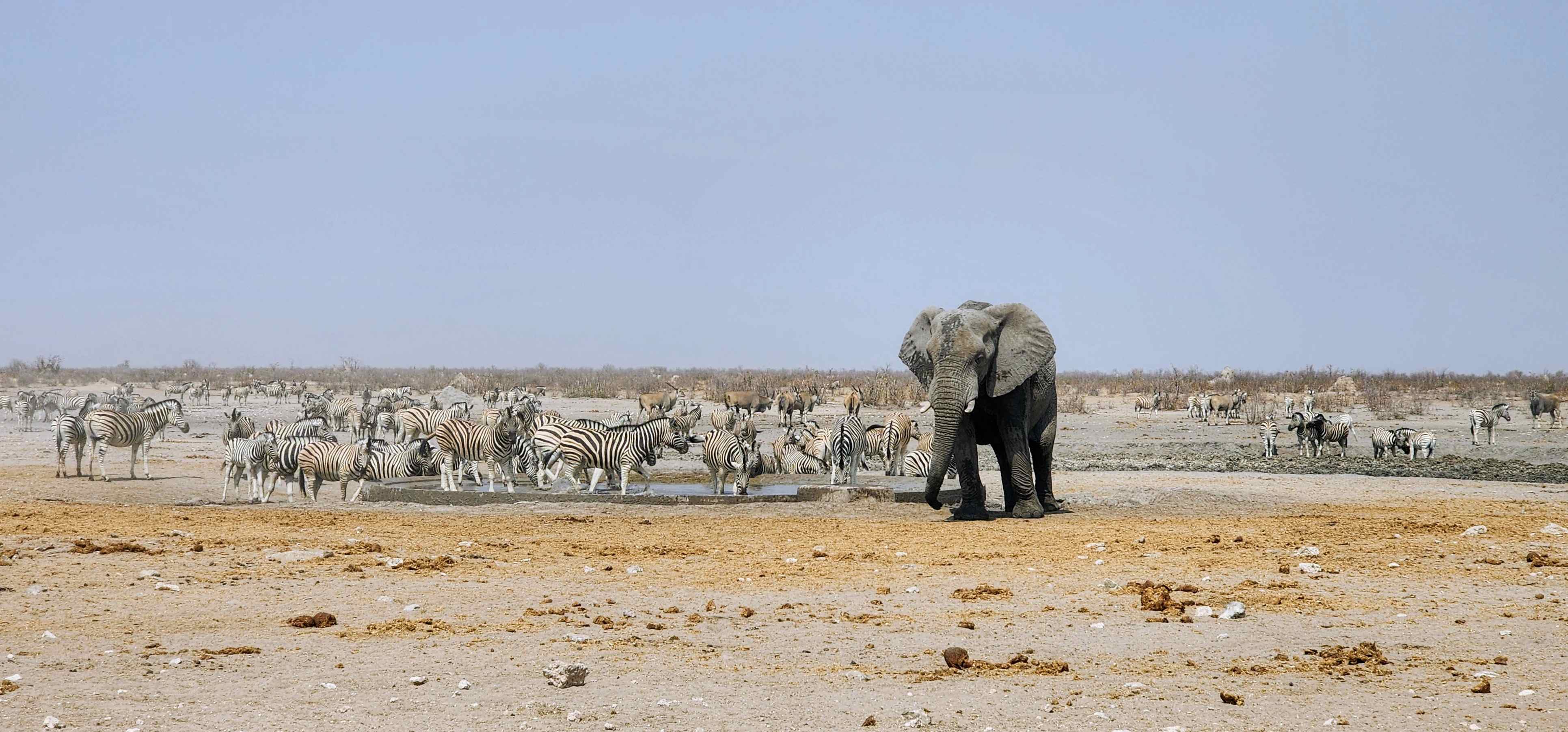
Upon arrival at Olifantsrus Camp, we experienced a truly intimate encounter. An enormous elephant came right up to our dedicated viewing area, so incredibly close that we could distinctly hear the rhythmic flap of its ears as it cooled itself off from the dry heat of the day. It was a privileged moment, witnessing such a grand creature in its natural state, undisturbed by our presence.
However, the beauty and privilege of this location also come with incredibly poignant and sad stories. Olifantsrus, meaning “elephant rest” in Afrikaans, carries a difficult history that speaks to the complex challenges of wildlife conservation.

Historically, the number of elephants in this specific area of Etosha had dramatically increased, from approximately 500 in 1967 to around 3,000 by 1983. This surge was largely attributed to immigration, as elephants migrated into the park seeking refuge from intense poaching pressures in northwestern Namibia. As these magnificent herds continued to find sanctuary here, they reproduced, leading to a significant increase in population density.
The years between 1983 and 1985 saw a severe drought grip the region, leading to a devastating decline in local grasses and vegetation. Park rangers faced an agonizing dilemma: they were gravely worried about potential desertification in the area, which would have catastrophically threatened the long-term survival of all local wildlife, including critically endangered species like the black rhinoceros, as well as the very elephants they were trying to protect.
In a heartbreaking effort to prevent wider ecological collapse, a difficult decision was made. Between 1983 and 1985, a total of 525 elephants were culled. These culled animals were then driven to Olifantsrus. Even today, at the campsite, a stark reminder of this painful period remains: massive steel structures, once used to hoist the animals for butchering, stand as silent monuments to the drastic measures taken in the name of conservation. It’s a sobering testament to the difficult choices faced by those managing wild spaces in the face of environmental pressures and human impact.
Our time in this part of Etosha brought us face-to-face not only with incredible wildlife but also with the profound and often challenging realities of conservation in such fragile ecosystems. It deepened our appreciation for the delicate balance of nature and the dedicated efforts to preserve it.
With our Etosha safari complete, we now prepare for a significant change of scenery. Next, we embark on a Scenic Journey to Swakopmund, trading vast plains for the dramatic coastal desert!
Previous <— This entry is part of a trip. Continue the story? —> Forward
Helpful Links
- Travel Guides: Since this was a self-drive road trip in a very sparse part of the world, I actually have several tools to share here. I cannot suggest Tracks4Africa enough.
- Namibia Self-Drive Guide by Tracks4Africa
- Namibia Map by Tracks4Africa
- Insight Guides Namibia (Travel Guide with Free eBook): I actually use these more and more over Lonely Planet these days.
- Camping in Etosha:
- Namutoni Camp – This is where we stayed on our first night in Etosha, on the eastern side of the park.
- Okaukuejo Camp – Our second night provided a more central location and the best watering hole, where we saw rhinos!
- Olifantsrus Camp – Our last camp, and the most western located. This is where we learned the history of the park with regard to elephants.
- Etosha National Park Official Website
- Olifantsrus – Travel News Namibia
Stepping Thru Our Story:
- Exploring Southern Africa: A Journey Through Namibia and Botswana
- Understanding Johannesburg’s Complex Past and Present
- Exploring Soweto: A Walking Tour Through History
- A Journey through Windhoek: History and Highlights
- Camping Under the Stars in Botswana’s Kalahari Desert
- Discover Wildlife in the Okavango Delta: Canoe and Safari Experiences
- Exploring Wildlife in Chobe National Park
- Navigating Chobe’s Sand: A Journey Through Savuti
- Explore Chobe Riverfront: A Wildlife Paradise
- Victoria Falls: The Mighty Wonder Between Zimbabwe and Zambia
- Exploring Victoria Falls: A Guide to Zambia’s Hidden Gems
- Driving the Caprivi Strip
- Exploring Namibia’s Etosha National Park
- Exploring Etosha: Elephants and Conservation Stories
- A Scenic Journey to Swakopmund from Etosha National Park
- Exploring the Namib Desert: A Guide to Sossusvlei and Deadvlei
- Lost in Namibia: A Travel Experience to Remember


Leave a Reply