After traversing the unique Caprivi Strip, our Southern African odyssey brought us to a destination that many consider Namibia’s safari crown jewel: Etosha National Park. Located in northwestern Namibia, Etosha is not just one of the largest national parks in Africa, but also one of the most distinctive. Covering an immense area of approximately 8,598 square miles (22,269 square kilometers), the park is famously centered around the Etosha Pan – a vast, shimmering expanse of salt, a prehistoric lakebed that dominates the landscape. Scattered across this saline desert are numerous lone salt springs, which act as vital salt licks and, crucially, waterholes for the park’s abundant wildlife. During the dry season, these waterholes become magnets, drawing thirsty animals from across the plains, making them prime locations for incredible wildlife viewing.
Our arrival in Etosha, after several days of driving from Victoria Falls and across the Caprivi, was met with eager anticipation. We quickly selected our first campsite within the park, settled in, and toasted our arrival with a well-deserved glass of wine. As evening descended, we set out for our first safari drive within Etosha. It wasn’t long before we were rewarded with a thrilling sight: a glimpse of our third big cat of the trip – a pair of sleek cheetahs! Having previously spotted lions and leopards in Botswana, this sighting was a fantastic addition to our burgeoning list of apex predators.

Over the following days, we dedicated ourselves to exploring Etosha’s sprawling savannahs. Our game drives yielded constant sightings of diverse animals: herds of striped zebras, robust blue wildebeests, striking red hartebeests, and graceful impalas. We watched fascinatingly as spotted hyenas cautiously approached waterholes, their powerful frames shimmering in the warm Namibian light as they took long, satisfying drinks. While lions and cheetahs made appearances, it was the sheer abundance of elephants, giraffes, and ostriches that truly dominated the landscapes, their presence a constant reminder of the park’s thriving ecosystem.
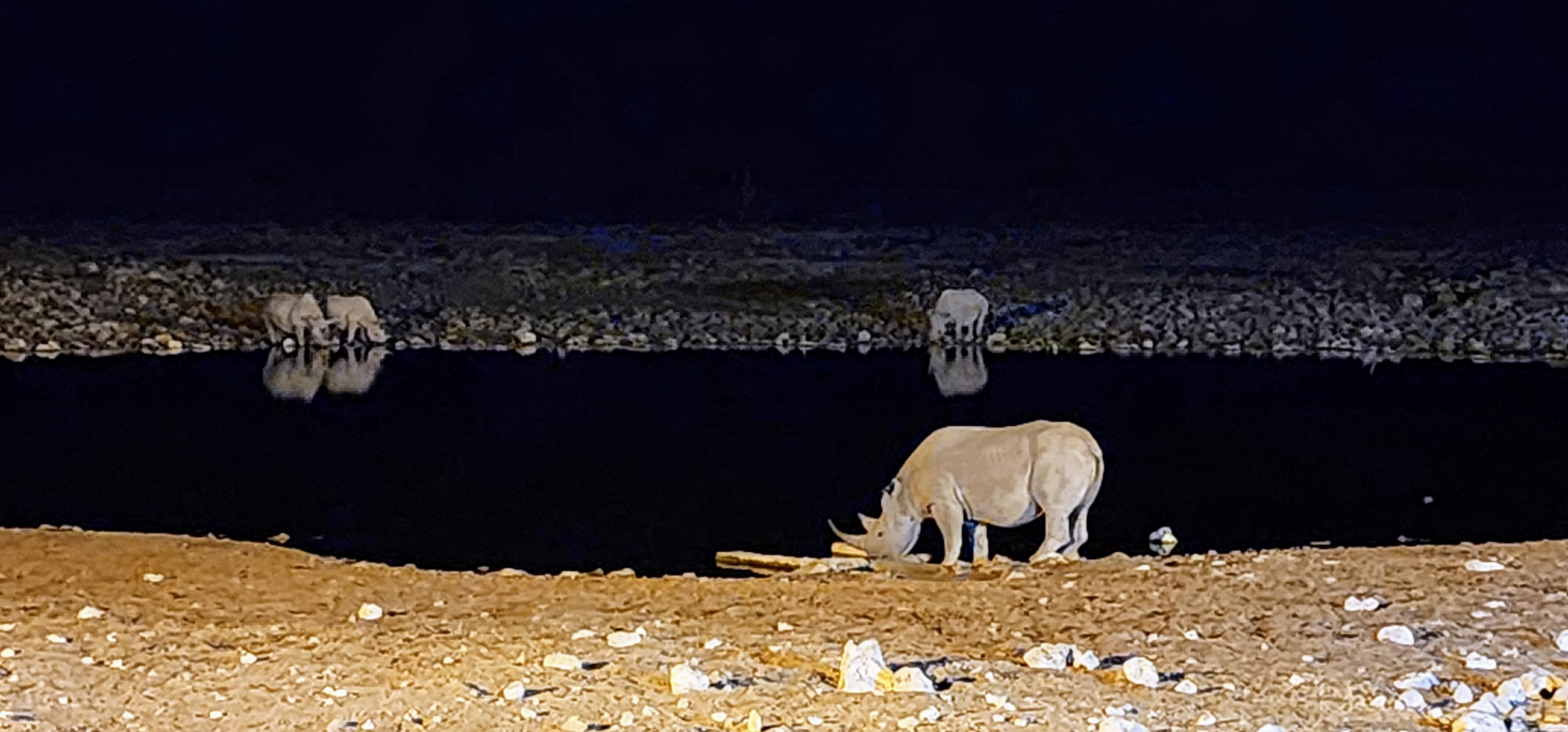
Then came an evening encounter that will forever be etched in our memories. On our way back to camp, just as the day was fading, we had our first white rhinoceros sighting of the entire trip! It was an utterly magical moment. With no other cars around, this magnificent creature was walking directly towards us, approaching so close that we could practically have touched it from the safety of our truck. We immediately stopped the vehicle, holding our breath, simply watching in awe. The proximity allowed for some truly amazing photographic opportunities, capturing the sheer scale and beauty of this endangered species. (Sadly, due to unforeseen circumstances later in the trip, we no longer possess these precious photos, but the vivid memory remains!). Later that same evening, we were delighted to see more rhinos come to have a drink at the waterhole right near our camp – a first for both of us to witness such an incredible spectacle right on our doorstep!
Etosha National Park, with its unique geology and concentrated wildlife viewing, proved to be an extraordinary safari experience, unlike any other on our journey. The vastness of the pan and the intimate encounters at the waterholes provided unforgettable moments.
Our exploration of Etosha was far from over. Next, we delve deeper into the lives of Etosha’s incredible elephants and share some insights into the vital conservation stories unfolding within the park.
Previous <— This entry is part of a trip. Continue the story? —> Forward
Helpful Links
- Travel Guides: Since this was a self-drive road trip in a very sparse part of the world, I actually have several tools to share here. I cannot suggest Tracks4Africa enough.
- Namibia Self-Drive Guide by Tracks4Africa
- Namibia Map by Tracks4Africa
- Insight Guides Namibia (Travel Guide with Free eBook): I actually use these more and more over Lonely Planet these days.
- Camping in Etosha:
- Namutoni Camp – This is where we stayed on our first night in Etosha, on the eastern side of the park.
- Okaukuejo Camp – Our second night provided a more central location and the best watering hole, where we saw rhinos!
- Olifantsrus Camp – Our last camp, and the most western located. This is where we learned the history of the park with regard to elephants.
- Etosha National Park Official Website
- Etosha Pan – UNESCO World Heritage Centre
- When is the best time to visit Etosha National Park?
Stepping Thru Our Story:
- Exploring Southern Africa: A Journey Through Namibia and Botswana
- Understanding Johannesburg’s Complex Past and Present
- Exploring Soweto: A Walking Tour Through History
- A Journey through Windhoek: History and Highlights
- Camping Under the Stars in Botswana’s Kalahari Desert
- Discover Wildlife in the Okavango Delta: Canoe and Safari Experiences
- Exploring Wildlife in Chobe National Park
- Navigating Chobe’s Sand: A Journey Through Savuti
- Explore Chobe Riverfront: A Wildlife Paradise
- Victoria Falls: The Mighty Wonder Between Zimbabwe and Zambia
- Exploring Victoria Falls: A Guide to Zambia’s Hidden Gems
- Driving the Caprivi Strip
- Exploring Namibia’s Etosha National Park
- Exploring Etosha: Elephants and Conservation Stories
- A Scenic Journey to Swakopmund from Etosha National Park
- Exploring the Namib Desert: A Guide to Sossusvlei and Deadvlei
- Lost in Namibia: A Travel Experience to Remember


Leave a Reply