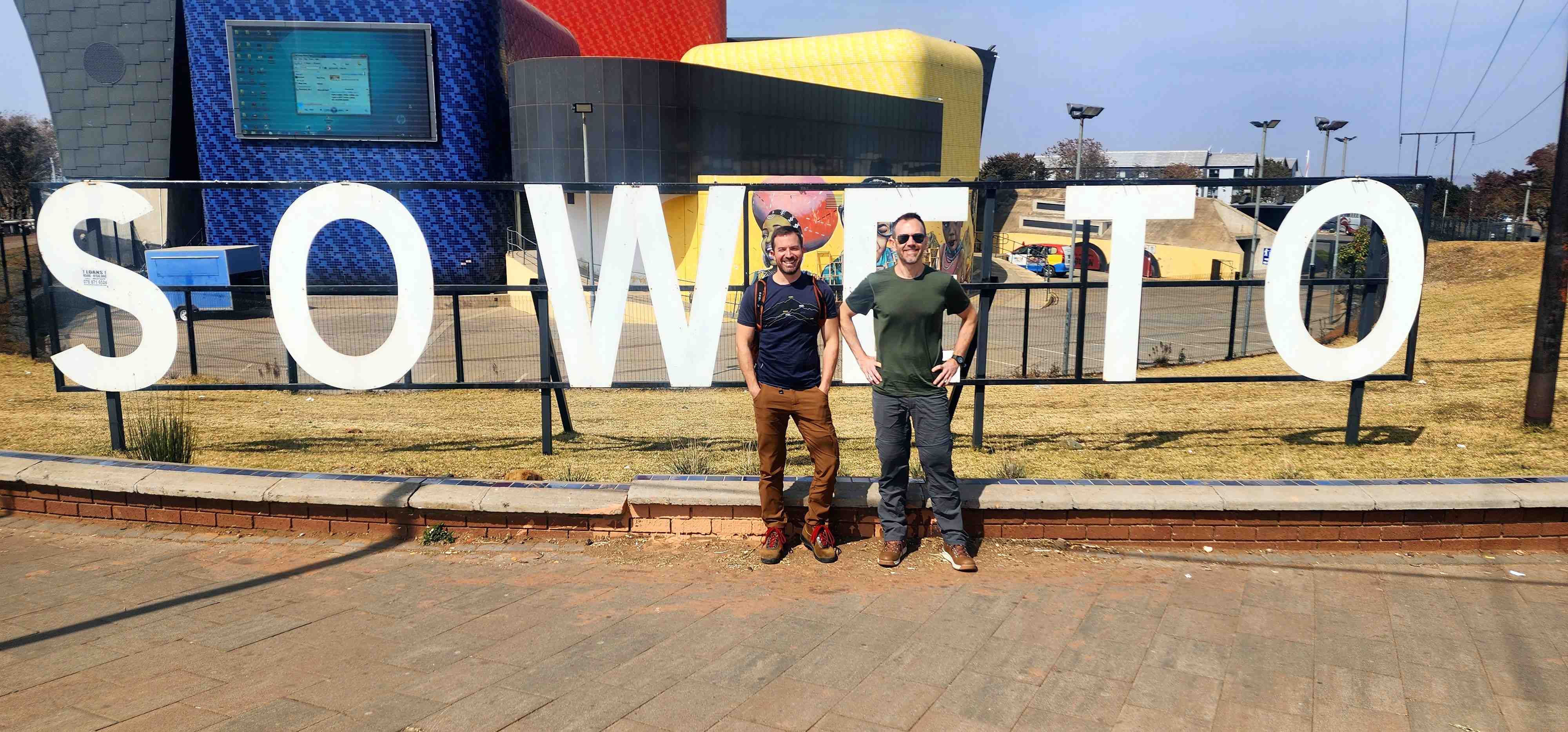
Following our initial, eye-opening exploration of Johannesburg’s CBD, our brief but impactful time in the city continued with an activity that truly deepened our understanding of South Africa’s past: a walking tour of Soweto. This immersive experience peeled back layers of history and uncovered stories of struggle, resilience, and triumph, stories that, shockingly, we had never fully been aware of.
The name Soweto itself, an acronym for South Western Townships, was formally adopted in 1963 to describe the sprawling collection of townships southwest of Johannesburg. Under the brutal apartheid government, black South Africans were systematically and forcefully relocated from the city center and surrounding areas into Soweto. These forced removals were designed to separate black communities from white suburbs by so-called “cordons sanitaires” – usually natural barriers like rivers or man-made divisions like railway lines, creating stark geographical and social divides.


Soweto tragically captured the world’s attention on June 16, 1976, a date seared into the collective memory of South Africa.4 On that day, protests erupted over the government’s draconian policy to enforce education exclusively in Afrikaans, rather than allowing students to learn in their native languages. What began as a peaceful march of approximately 10,000 students heading to Orlando Stadium escalated horrifyingly when police opened fire. The ensuing riots continued, and by the end of that horrific first day, 23 people had died in Soweto, including the innocent minor, Hector Pieterson, a 13-year-old boy whose death became an iconic symbol of the brutality of apartheid.
The reverberations of the Soweto Uprising were felt across the globe. In its immediate aftermath, economic and cultural sanctions against the apartheid regime were introduced from abroad, signaling international condemnation. Domestically, the uprising galvanized resistance, prompting many political activists to leave the country to train for guerrilla warfare, further escalating the struggle for liberation. Soweto, already a symbol of oppression, became a critical stage for violent state repression, but also for burgeoning resistance.

Since 1991, the indelible date of June 16th and the sacrifice of those schoolchildren have been commemorated annually as Youth Day in South Africa, a public holiday honoring the country’s youth and their role in the struggle for liberation. Memorials, like the Hector Pieterson Memorial and Museum, stand today as powerful reminders, vividly describing the horrible results of that day and ensuring that these crucial events are never forgotten.
Our walking tour led us to Vilakazi Street, arguably the most famous thoroughfare in Soweto, and indeed, one of the most historically significant streets in the world. It holds the extraordinary distinction of being the only street globally to have produced two Nobel Peace Prize winners: the revered Nelson Rolihlahla Mandela and the esteemed Archbishop Desmond Tutu. Both lived humble lives on this very street, becoming titans in the fight against apartheid. It is also tragically close to here that Hector Pieterson was shot dead, sparking the fateful riots on June 16, 1976. On Vilakazi Street, we find the Mandela House, now a museum, offering an intimate glimpse into the early life of the man who would become South Africa’s first democratically elected president.


Walking these streets, seeing the homes, the memorials, and feeling the vibrant pulse of Soweto today, provided a profound contrast to the devastating history. It was an essential experience that transcended mere sightseeing, offering a powerful lesson in human courage and the enduring fight for justice.
In my next post, I’ll shift gears entirely as we begin our self-drive journey, heading into the untamed beauty of Namibia!
Previous <— This entry is part of a trip. Continue the story? —> Forward
Helpful Links
- Free tour of the history and lifestyle of Soweto
- Places to stay in Johannesburg
- Soweto – Wikipedia
- Soweto uprising – Wikipedia
- Apartheid – Wikipedia
- Mandela House – 8115 Vilakazi St, Orlando West, Soweto
Stepping Thru Our Story:
- Exploring Southern Africa: A Journey Through Namibia and Botswana
- Understanding Johannesburg’s Complex Past and Present
- Exploring Soweto: A Walking Tour Through History
- A Journey through Windhoek: History and Highlights
- Camping Under the Stars in Botswana’s Kalahari Desert
- Discover Wildlife in the Okavango Delta: Canoe and Safari Experiences
- Exploring Wildlife in Chobe National Park
- Navigating Chobe’s Sand: A Journey Through Savuti
- Explore Chobe Riverfront: A Wildlife Paradise
- Victoria Falls: The Mighty Wonder Between Zimbabwe and Zambia
- Exploring Victoria Falls: A Guide to Zambia’s Hidden Gems
- Driving the Caprivi Strip
- Exploring Namibia’s Etosha National Park
- Exploring Etosha: Elephants and Conservation Stories
- A Scenic Journey to Swakopmund from Etosha National Park
- Exploring the Namib Desert: A Guide to Sossusvlei and Deadvlei
- Lost in Namibia: A Travel Experience to Remember


Leave a Reply