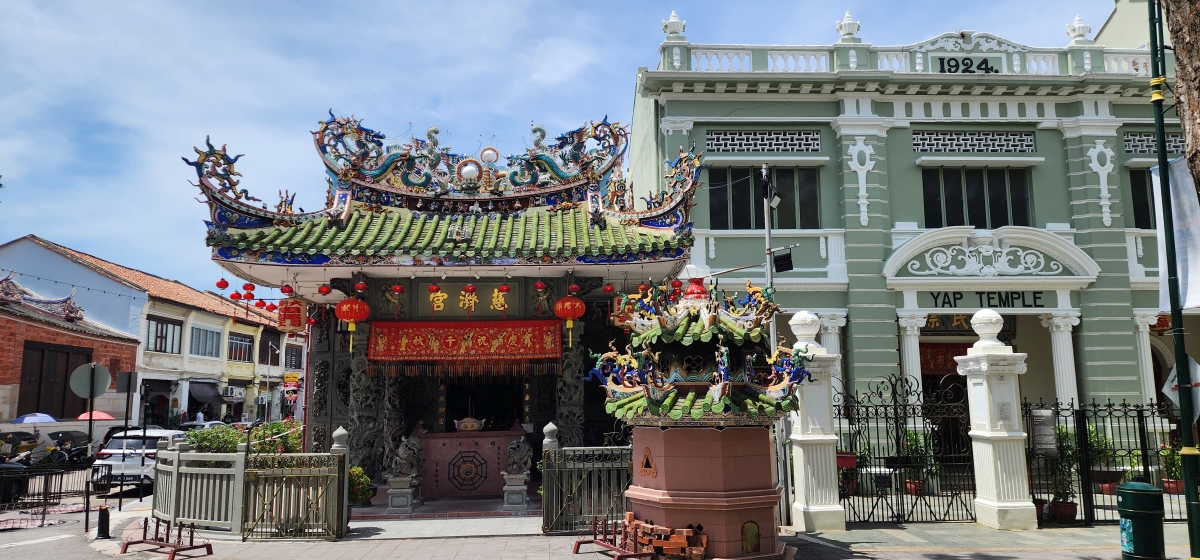
Walking through George Town, it can be easy to feel as though you are reading different chapters of the same story. The history of the Chinese in Penang, Malaysia has many different facets.
Lured by the promise of fortune in this once booming British port, waves of immigrants left Southern China for this small island. It was a land of opportunity, but also of immense hardship. The story of their journey, their struggles, and their successes is written in wood and stone across the city, from grand mansions and temples to the humblest seaside piers.

This story is most clearly described through its two opposing extremes: the opulent homes of the fabulously wealthy and the communal villages built on stilts over the Strait of Malacca, the narrow, funnel-shaped stretch of water connecting the Indian Ocean and the South China Sea.
The Established Elite: The Baba-Nyonya
First, there were the established elite, the Peranakan, or Baba-Nyonya (the names for the men and women respectively). These were the descendants of the earliest Chinese traders who had settled in the Malay Archipelago for generations, adapting to local customs and creating a unique, aristocratic hybrid culture. Their wealth was old and their influence strong. The story of their refined and lavish lifestyle is preserved in the Pinang Peranakan Mansion (the Green Mansion). Now a museum, the Pinang Peranakan Mansion once served as the residence and office of a 19th-century Chinese tycoon, Chung Keng Quee.

Visiting it was like stepping into a jewel box. While once a home, today is showcases more than a thousand Peranakan artifacts and antiques. The artifacts are styled by a culture that blended Chinese, Malay, and European influences—a world of intricate beadwork, Scottish iron railings, and other priceless antiques, such as the carved wooden panels and screen for the walls. Like many of the Chinese townhouses of the era, it is fitted with several interior courtyards.


There is a small fee (RM30.00) to get into the museum, and the cost is worth the viewing. There are also free tours, as I pleasantly learned when I arrived just around 11:30, though I found that there were far too many people around for me to hear the guide.
The Newcomers: Hardship and Kinship
Then, in the 19th century, came the Sinkheh—a Cantonese term meaning “new guests” or newcomers. These were poor, hardworking laborers and traders, fleeing hardship in China with dreams of making their fortune in this bustling port. For them, survival in a new land depended entirely on community and kinship.
This is the story of the Clan Jetties. A walk along the waterfront led me to this other chapter of history entirely. These weren’t just docks; they were floating villages built on stilts over the water, each jetty belonging to a specific clan—the Chew, the Lim, the Tan. The simple wooden houses, the narrow boardwalks, and the small temples all speak of a life where community was the only safety net. It was a reminder that for every tycoon, there were thousands of ordinary people working together just to get by.


The Self-Made Wealth
And then there were those who succeeded on an unimaginable scale, the Towkays (wealthy and influential businessmen) who arrived with nothing and built empires. This is the rags-to-riches story personified by the Cheong Fatt Tze Mansion (the Blue Mansion). If the Peranakan Mansion was a delicate jewel box, the Blue Mansion was a fortress of ambition.

Now a boutique hotel, the Mansion was built by Cheong Fatt Tze, “the Rockefeller of the East,” who aspired to house his descendants in a home that personifies the essence of majesty and elegance. Cheong Fatt Tze was originally poor youth who fled the Second Opium War in Guangdong, China. He found destiny in Southeast Asia where he prospered as an industrialist, politician, and philanthropist. The mansion housed himself, eight wives, and six sons.
The mansion has five grand courtyards, further articulating the bold and grand styling. Completed in 1904, the mansion also has two floors, 38 rooms, seven staircases, and 220 Gothic louvered windows. With an eye for detail and excellence, Cheong Fatt Tze was determined to use only the best materials for his mansion. He shipped artisans in from Southern China and imported building materials from as far as Scotland.

The audio tour told the story of its owner, a self-made tycoon who built a commercial empire across Asia. The house, with its imposing indigo walls and masterful feng shui design, wasn’t just a home; it was a statement of power, a declaration that a newcomer had arrived and conquered. If not staying at the hotel, you will be heavily limited in the rooms you can enter, but I still found it very much worth the visit on the day that I spent learning of the Chinese history and impacts on Penang Island.
The Social Bridge
Tying these disparate communities together were the communal halls, or Kongsi, like the magnificent Khoo Kongsi. These were not private homes but elaborate communal structures that served as the headquarters for each clan. They were a place of worship, a community center, and a powerful symbol of a clan’s collective wealth, providing a crucial social bridge between the humble workers on the jetties and the powerful merchants in their mansions.

First built in 1851, Leong San Tong Khoo Kongsi (or Khoo Kongsi for short) is the largest Hokkien clan house in Malaysia. The Khoo Kongsi is a clan association of the Leong San Tong (Dragon Mountain Hall) clan, whose forefathers came from XinAn Village in Fujian province and were of Hoklo descent. These Khoos were among the wealthy Straits Chinese traders of 17th-century Malacca and early Penang. In the 19th century, the clan complex resembled a miniature clan village, complete with its own self-government as well as educational, financial, welfare, and social organizations. The clan temple itself was rebuilt in 1906, when the Khoo clan was at the height of its wealth and eminence in Penang society.


The mansions and the jetties are more than just photo opportunities. They are the physical anchors of a complex social history, telling a vital story of class, ambition, and belonging. To see them on the same day is to truly understand the different paths taken, the fortunes won, and the communities that held it all together in the crucible of George Town.
Practical Information for Your Visit
Location: All three key sites—the Pinang Peranakan Mansion, the Cheong Fatt Tze Mansion, and the Khoo Kongsi—are located within a relatively short walking distance of each other in the UNESCO Heritage Zone.
Tour Timing: The Blue Mansion (Cheong Fatt Tze) is accessible only via guided tour, so reserve your spot in advance. The Green Mansion (Peranakan) is generally self-guided but can be very busy. If time is tight, consider a guided tour to get the most of your time.
Jetties Etiquette: The Clan Jetties are along Weld Quay and are active residential communities. Be respectful of residents’ privacy, keep to the public walkways, and consider supporting the small businesses there.
Thematic Pairing: Plan to visit one of the grand mansions in the morning and end your day at a quiet spot like Tan Jetty to experience the visual contrast between colonial wealth and community resilience.
Helpful Links
- Official Web Site: Pinang Peranakan Mansion
- Hotel Information: Cheong Fatt Tze, the Blue Mansion
- Guided Tour Options for Penang’s Historic Homes
- Read More: Learn more about my time in Penang in my post, Exploring Penang: A Culinary and Cultural Journey.


Leave a Reply